Kuma Cantina
A bilingual marketing site and a human-in-the-loop AI inquiry assistant for a Mexican cantina and cocktail bar in Tokyo.
- Role
- Solo build for a client
- Year
- 2026
- Status
- Live
- HTML/CSS/JS
- Next.js
- Claude API
- Resend
- Vercel
What it is
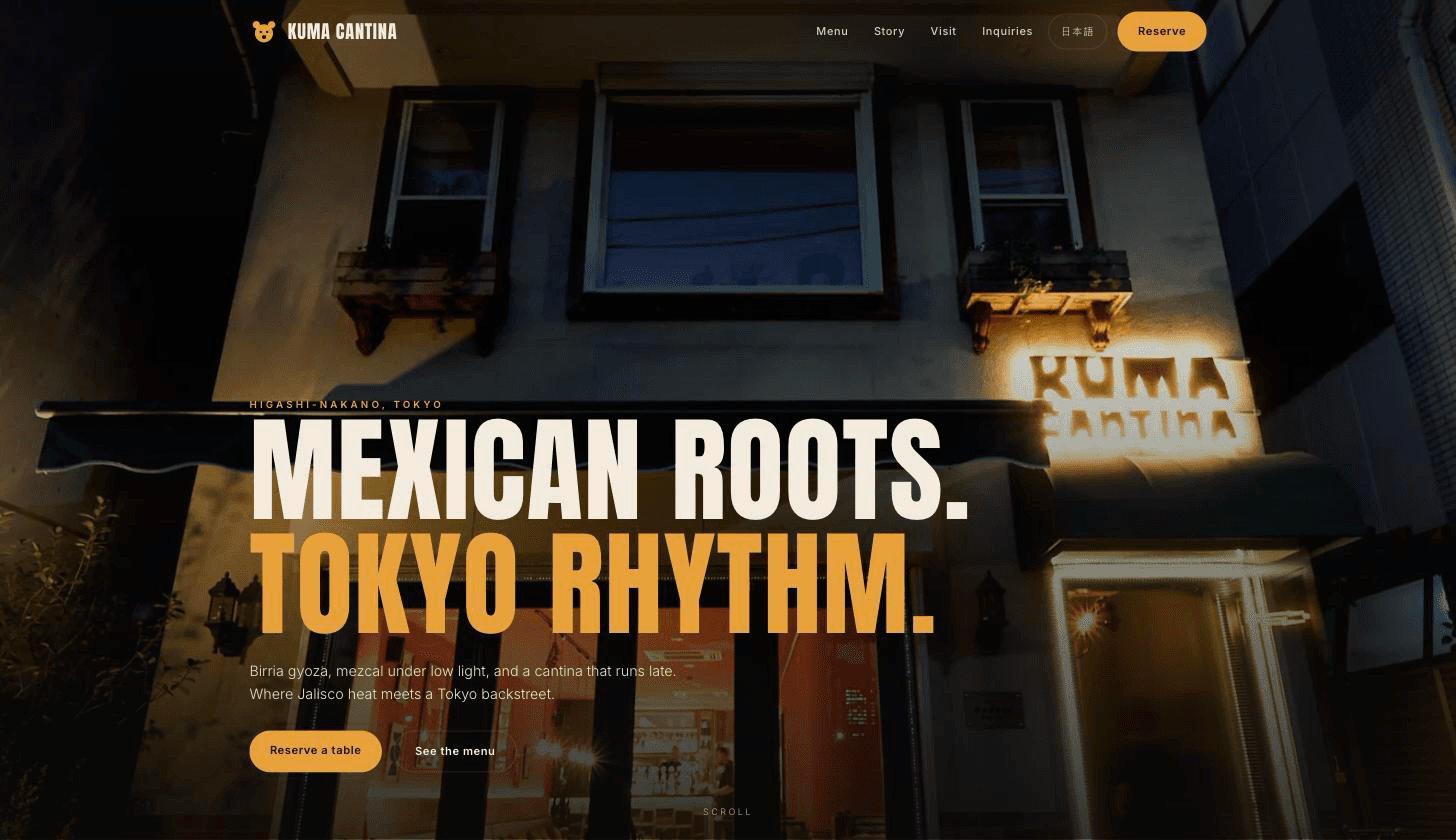
Kuma Cantina is a Mexican cantina and cocktail bar in Higashi-Nakano, Tokyo. The engagement was one client, two deliverables: a public marketing site that matches the room, and an AI-assisted inquiry system that handles everything a reservation button can't. Both are bilingual, because the restaurant's audience is.
The website
The site is dark by design, built for the hours the restaurant actually keeps. A browsable menu, an embedded map, and a one-tap language toggle that switches the whole page between English and 日本語 instantly, no reload. Reservations go to the restaurant's existing TableCheck system rather than a new booking flow, because the staff already work in TableCheck and the site's job is to hand guests off to it cleanly.
It is hand-built HTML, CSS, and JavaScript with client-side i18n and optimized self-hosted WebP images, deployed on Vercel. No framework, no build step to babysit. That was the point: the site loads fast on a phone outside the door, and a menu price can be changed in minutes.
The inquiry assistant
Reservations have a system. Everything else lands in the owner's inbox: job applications, large-party requests, catering. The inquiry assistant is a bilingual form (Japanese by default, English one tap away) that classifies the request, drafts a reply in the owner's voice with the Claude API, and routes the draft to the owner to approve and send.
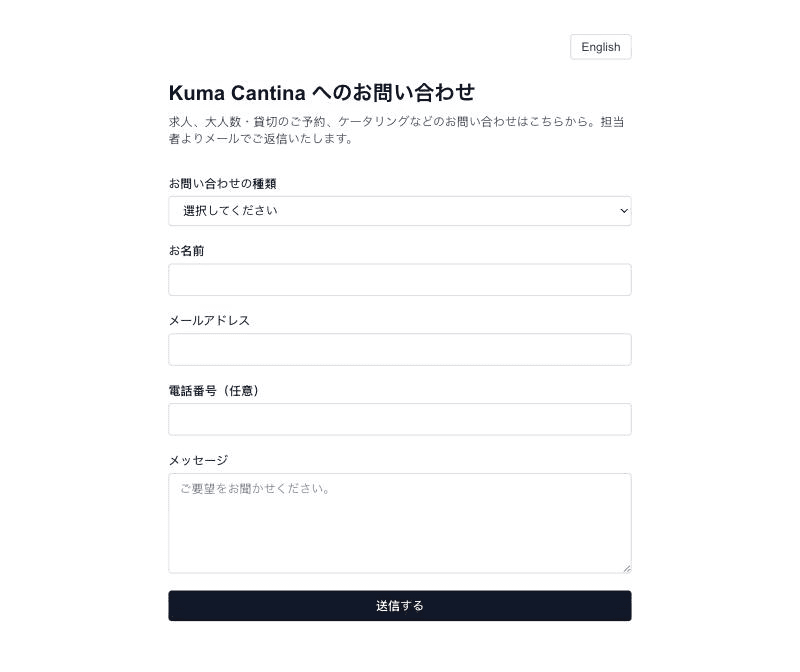
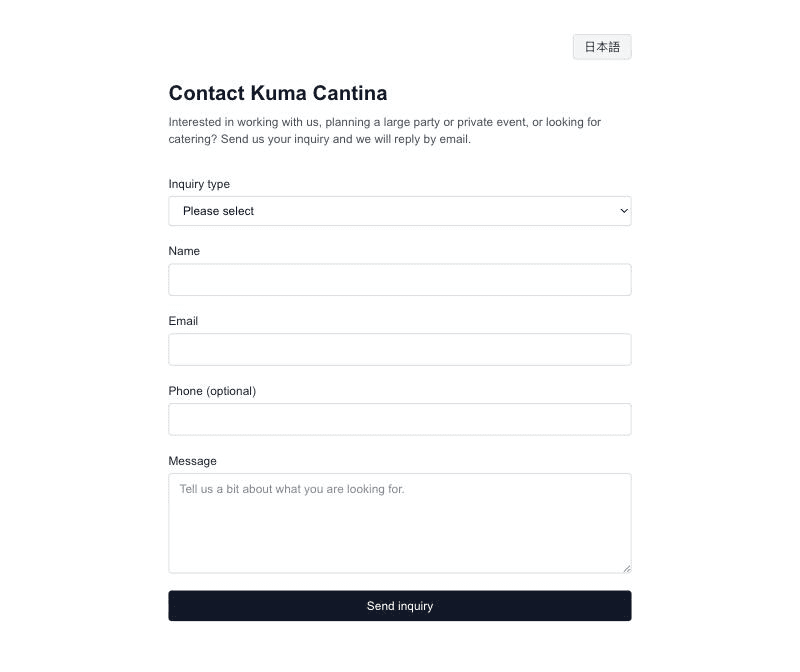
The human stays in the loop on purpose. Replies go out fast and still sound like the restaurant, and nothing model-written reaches a customer unseen. It is the same review-first pattern as the hwb2 | Learning intake pipeline, applied to a different business: AI does the repetitive drafting, a person owns the send.
The assistant is live and routes real submissions to the owner's inbox, which is why this page shows it as screenshots rather than linking to the form.
Stack
The website is intentionally minimal: hand-built HTML, CSS, and JavaScript with client-side bilingual i18n and self-hosted WebP images, on Vercel. The inquiry assistant is a Next.js app in TypeScript and Tailwind: Formspree receives the form, the Claude API classifies the inquiry and drafts the reply, and Resend delivers the draft to the owner for approval. Both deploy on Vercel.
Status
Both deliverables are live: the site at kuma-cantina-mockup.vercel.app, and the assistant routing real inquiries to the owner.